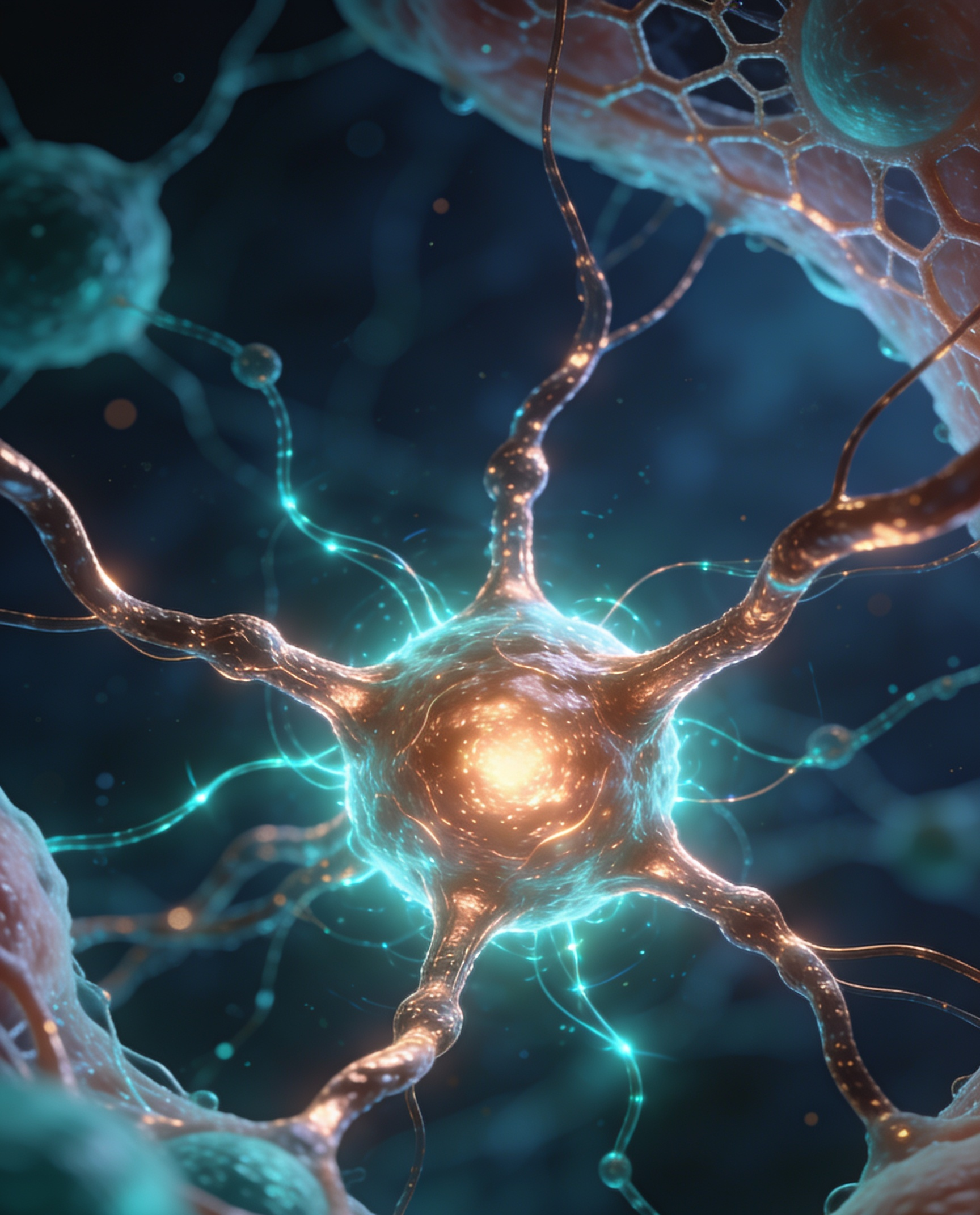
GHK-Cu interacts with the nervous system through a range of mechanisms, including significant anti-inflammatory, antioxidant, copper-regulating, and neurotrophic support properties. While it shows considerable promise in preclinical models for addressing key pathologies of neurodegenerative diseases, there is currently no published human clinical trial evidence demonstrating its efficacy for these conditions.
What the AI assistants say
AI assistants collectively describe GHK-Cu (glycyl-L-histidyl-L-lysine copper(II)) as a naturally occurring human tripeptide whose plasma levels decline with age. They agree that it efficiently crosses the blood-brain barrier in preclinical models, allowing for central nervous system effects. The core mechanisms of its interaction with the nervous system are consistently identified across all assistants:
- Anti-inflammatory effects: GHK-Cu suppresses neuroinflammation by reducing pro-inflammatory cytokines like TNF-α, IL-6, and IL-1β, inhibiting the NF-κB pathway, and modulating microglial activation (potentially shifting from a pro-inflammatory M1 to an anti-inflammatory M2 phenotype). One assistant also noted suppression of p38 MAPK signaling.
- Antioxidant and oxidative stress protection: It enhances the brain’s endogenous antioxidant defense system by upregulating enzymes such as superoxide dismutase (SOD), catalase, and glutathione peroxidase. It activates Nrf2, reduces reactive oxygen species (ROS) and lipid peroxidation, and can directly quench radicals.
- Copper homeostasis and prevention of metal-induced protein aggregation: GHK-Cu acts as a physiological copper-binding ligand, safely delivering copper to cells while preventing the accumulation of free copper, which can cause oxidative damage (e.g., via the Fenton reaction). It is also reported to prevent copper- and zinc-induced amyloid-beta and alpha-synuclein aggregation, which are critical in Alzheimer’s and Parkinson’s diseases.
- Neurotrophic support and nerve regeneration: GHK-Cu promotes neuronal survival, growth, and regeneration by increasing the expression of neurotrophic factors like Nerve Growth Factor (NGF), Brain-Derived Neurotrophic Factor (BDNF), Glial Cell Line-Derived Neurotrophic Factor (GDNF), and Vascular Endothelial Growth Factor (VEGF). It supports neurogenesis, synaptogenesis, and axon differentiation, with one assistant also mentioning its role in angiogenesis.
- Modulation of gene expression: GHK-Cu is reported to upregulate genes involved in tissue repair and anti-apoptosis, while suppressing pro-apoptotic genes. It can also influence genes linked to neurons, glia, astrocytes, and myelin, and mobilize neural and mesenchymal stem cells.
While the AI assistants largely agree on these mechanisms, they differ in their level of detail regarding specific studies or nuances. For instance, some provided specific examples of animal models (LPS-induced lung injury, rat intracerebral hemorrhage, C57BL/6 spatial memory, 5xFAD Alzheimer’s mouse model) and noted a specific 2024 *Metallomics* study on metal aggregation. However, all AI assistants strongly and consistently emphasize that despite promising preclinical (animal and cell culture) evidence, there are *no published human clinical trials* demonstrating the efficacy of GHK-Cu for Alzheimer’s, Parkinson’s, or other neurodegenerative diseases. They explicitly state that it is a “promising neuroprotective research compound” but not a “proven neurodegenerative-disease therapy,” highlighting a significant “translational gap.”
What the research actually shows
GHK-Cu, the copper complex of the human tripeptide glycyl-L-histidyl-L-lysine (GHK), exhibits a range of interactions with the nervous system and holds potential implications for the prevention and treatment of neurodegenerative diseases. The peptide GHK has a high affinity for copper ions and readily forms the complex GHK-Cu, which has been shown to possess antioxidant, anti-inflammatory, and regenerative properties [13]. These properties are particularly relevant to neurodegenerative diseases, as they are often characterized by oxidative stress, neuroinflammation, and disrupted metal homeostasis [13].
One of the key mechanisms by which GHK-Cu interacts with the nervous system is through its antioxidant action. The brain is susceptible to oxidative damage due to its high metabolic activity and relative lack of antioxidants. GHK-Cu can help mitigate this damage by regulating copper metabolism, which is essential for the function of endogenous antioxidants like Cu- and Zn-dependent superoxide dismutase (Cu, Zn SOD1) [11]. Copper deficiency can lead to reduced SOD activity, which in turn can result in increased oxidative stress and potential neurodegeneration [11].
In addition to its antioxidant properties, GHK-Cu also exhibits anti-inflammatory effects, which are important in neurodegenerative diseases where inflammation plays a significant role. GHK-Cu has been shown to decrease proinflammatory cytokines such as TGF-beta and TNF-alpha, which are involved in the development of conditions like Alzheimer’s disease (AD) [19]. By suppressing inflammation, GHK-Cu may help slow the progression of neurodegenerative diseases.
GHK-Cu also promotes blood vessel growth, which is crucial for the health of the brain as it requires a constant supply of oxygen and nutrients. The peptide aids in reestablishing blood flow into damaged tissues through angiogenesis, anticoagulation, and vasodilation, thereby supporting the vascular network essential for brain health [19]. This property of GHK-Cu could be particularly beneficial in neurodegenerative diseases where vascular integrity is compromised.
Furthermore, GHK-Cu has been shown to increase the production of neurotrophic factors, such as brain-derived neurotrophic factor (BDNF), which play a protective role and can reduce oxidative damage in the nervous system [19]. By stimulating the outgrowth of cultured nerves and increasing the production of nerve growth factor and neurotrophins, GHK-Cu may promote nerve repair and regeneration in neurodegenerative conditions.
The ability of GHK-Cu to regulate gene expression is another significant aspect of its interaction with the nervous system. Recent studies have demonstrated that GHK can up- and downregulate a large number of human genes, including those critical for neuronal development and maintenance [13]. This suggests that GHK-Cu may have the potential to counteract the detrimental epigenetic modifications associated with aging and neurodegenerative diseases.
In conclusion, GHK-Cu interacts with the nervous system through multiple mechanisms, including antioxidant and anti-inflammatory actions, promotion of blood vessel growth, enhancement of neurotrophic factors, and regulation of gene expression. These properties make GHK-Cu a promising therapeutic agent against age-associated neurodegeneration and cognitive decline. The implications for neurodegenerative diseases are significant, as GHK-Cu may help prevent, slow the progression, or even reverse some of the damage associated with these conditions. However, further research is needed to fully understand the extent of GHK-Cu’s effects and to develop effective treatment strategies based on these findings.
Where AI Consensus and Research Diverge
The primary point of divergence lies in the emphasis on clinical translation. The AI assistants are very explicit and unified in stating that while GHK-Cu shows strong preclinical promise in animal and cell culture models, there is a complete absence of published human clinical trial evidence demonstrating its efficacy for neurodegenerative diseases. They caution that GHK-Cu is a “promising neuroprotective research compound” but not a “proven neurodegenerative-disease therapy.” The corpus-grounded answer, while acknowledging the need for “further research,” highlights the significant potential of GHK-Cu as a “promising therapeutic agent” based on its diverse mechanistic properties, without directly addressing the current lack of human clinical trials.
Bottom line: GHK-Cu interacts with the nervous system through multiple beneficial mechanisms, showing strong preclinical promise for neurodegenerative diseases, yet currently lacks supporting human clinical trial evidence.
References
- GHK-Cu may Prevent Oxidative Stress in Skin by Regulating — Pickart, Loren
- The Effect of the Human Peptide GHK on Gene Expression — Pickart, Loren
- The Human Tripeptide GHK-Cu in Prevention of Oxidative — Loren Pickart
Continue your research
Part of our GHK-Cu: Brain & Nervous System guide.
- What research supports the neuroprotective effects of GHK-Cu, and how might it be utilized in the treatment of neurological disorders?
- How does GHK-Cu affect neural cell survival and function, and what are its implications for neurodegenerative diseases?
- How does GHK-Cu influence neural plasticity and regeneration, and what are its implications for neurological disorders?
Related topics:
- What clinical evidence supports the use of GHK-Cu in the treatment of various medical conditions, including wound healing and neurodegenerative diseases?
- How does GHK-Cu influence copper homeostasis, and what are the potential health implications of these effects?
- How does GHK-Cu interact with extracellular matrix components to facilitate tissue repair and regeneration?