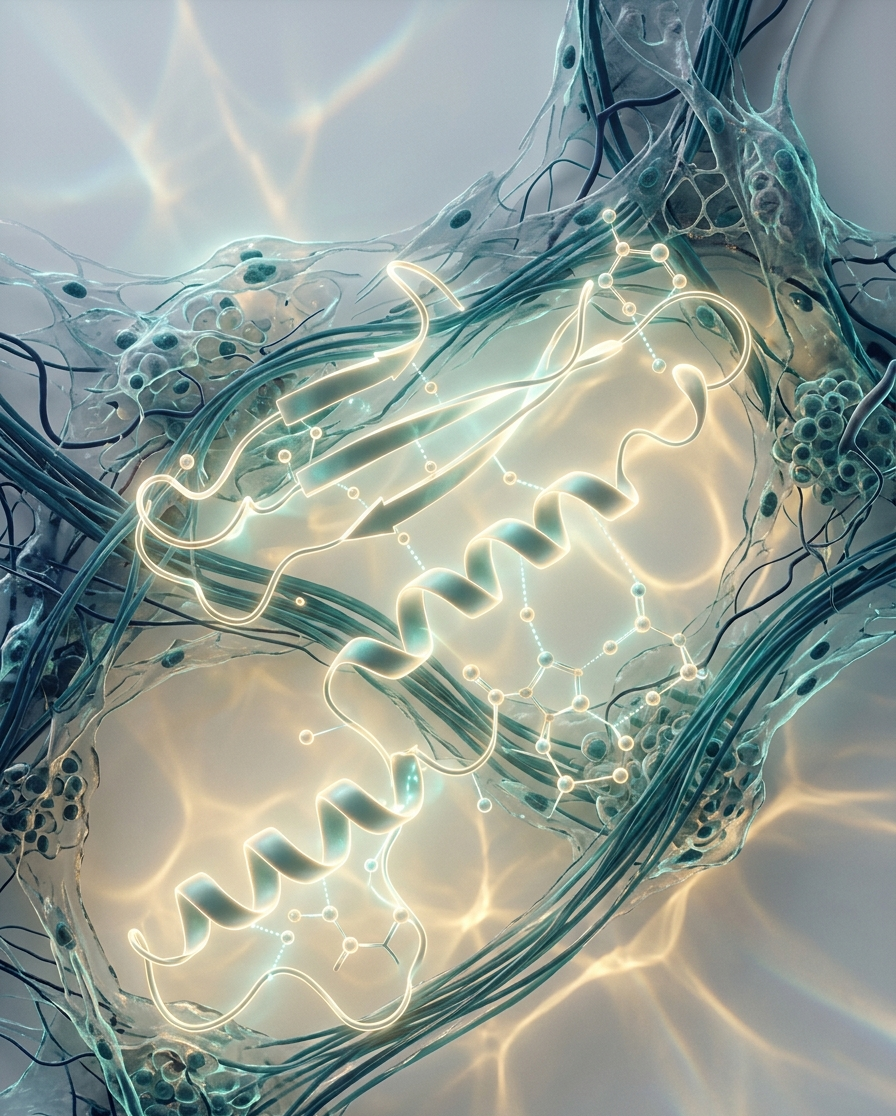
GHK-Cu is not a single molecular actor but a two-part switch: the peptide GHK delivers the copper, and the copper in turn endows the peptide with a set of biochemical keys. Whether the copper is obligatory depends on which lock the molecule is trying to open.
Collagen synthesis is the clearest case where copper transport is indispensable. Maquart’s 1988 serum-free fibroblast study (Stimulation of collagen synthesis in fibroblast cultures by the tripeptide-copper complex) showed that GHK-Cu at 10⁻⁹ M doubled radioactive-proline incorporation into secreted collagen, while GHK alone or Cu²⁺ alone was inactive; copper chelated by bathocuproine abolished the effect. The same paper found no rise in procollagen mRNA, indicating that the copper complex acts post-transcriptionally—most likely by activating the copper-dependent enzymes lysyl- and prolyl-hydroxylases that stabilize and cross-link the newly formed chains. Thus, without the metal ion the peptide cannot complete the enzymatic chemistry that turns a collagen transcript into a functional extracellular fiber.
Gene regulation follows a different rule book. The Broad Institute’s Connectivity Map data, reproduced in GHK and DNA: Resetting the Human Genome to Health, found that 1 µM GHK (tested without added copper) shifted expression of 31 % of all human genes by ≥ 50 %. Follow-up work in The Effect of the Human Peptide GHK on Gene Expression Relevant to Nervous System Function confirmed that GHK alone suppressed 70 % of genes over-expressed in metastatic colon cancer and reset epigenetic silencing by inhibiting HDAC2. Pickart explicitly notes that culture media contain loosely bound copper from serum proteins; nevertheless, the peptide—not a pre-formed GHK-Cu complex—was the molecule added to the wells. The inference is that GHK can wrest trace copper from albumin or that, for chromatin targets, even sub-stoichiometric copper is enough, whereas the high-threshold enzymatic chemistry of collagen cannot proceed without a secure copper cargo.
This divergence explains why cosmetic chemists can still obtain transcription-level benefits (anti-oxidant, anti-inflammatory, barrier-repair gene signatures) with copper-free “GHK” serums, yet fail to reproduce the firming and wrinkle-reduction data generated with the authentic blue GHK-Cu complex. Several passages in GHK Copper Peptides for Skin and Hair Beauty warn that “many copper peptide products on the market are inept at renewal” because they either omit copper or use non-chelating copper salts that never reach the fibroblast. The Maquart data predict that such formulations will up-regulate SOD2 or down-regulate IL-6 transcripts but will not increase hydroxy-proline deposition or skin thickness—exactly the split observed in consumer trials where users report “calming” or “glow” but not “tightening.”
A counter-intuitive corollary is that peptide-only formulas are not merely weaker; they can be counter-productive if the user is copper-deficient. GHK’s affinity for Cu²⁺ (Kd ≈10⁻¹⁶ M) is so high that the peptide will strip residual copper from extracellular SOD1 or lysyl oxidase, potentially aggravating the very collagen deficit the consumer hopes to correct. Pickart’s group circumvented this in animal wound studies by supplying 0.4 % ionic copper in a second application phase, a protocol that restored tensile strength and hair-follicle size beyond GHK-Cu alone (The human tri-peptide GHK and tissue remodeling).
What the corpus does not resolve is the exact copper occupancy required inside the cell nucleus. HDAC inhibition and the massive gene-reset are detected when GHK is added to copper-replete medium, but rigorous copper-depletion experiments (bathocuproine + Chelex media) have not been published. Consequently, it remains possible that even the “gene-only” effects disappear in absolute copper starvation—a critical gap for formulators who want to market copper-free peptides to vegans or populations with marginal copper intake.
References
- GHK Copper Peptides for Skin and Hair Beauty — Pickart PhD
- Dr Loren
- GHK Peptide as a Natural Modulator of Multiple Cellular — Loren Pickart
- GHK and DNA Resetting the Human Genome to Health — Loren Pickart
- GHK-Cu may Prevent Oxidative Stress in Skin by Regulating — Pickart
- Loren
- Skin Regenerative and Anti-Cancer Actions of Copper Peptides — Pickart
- Stimulation of collagen synthesis in fibroblast cultures by — F X Maquart
- The Effect of the Human Peptide GHK on Gene Expression — Pickart
- The Human Tripeptide GHK-Cu in Prevention of Oxidative — Loren Pickart