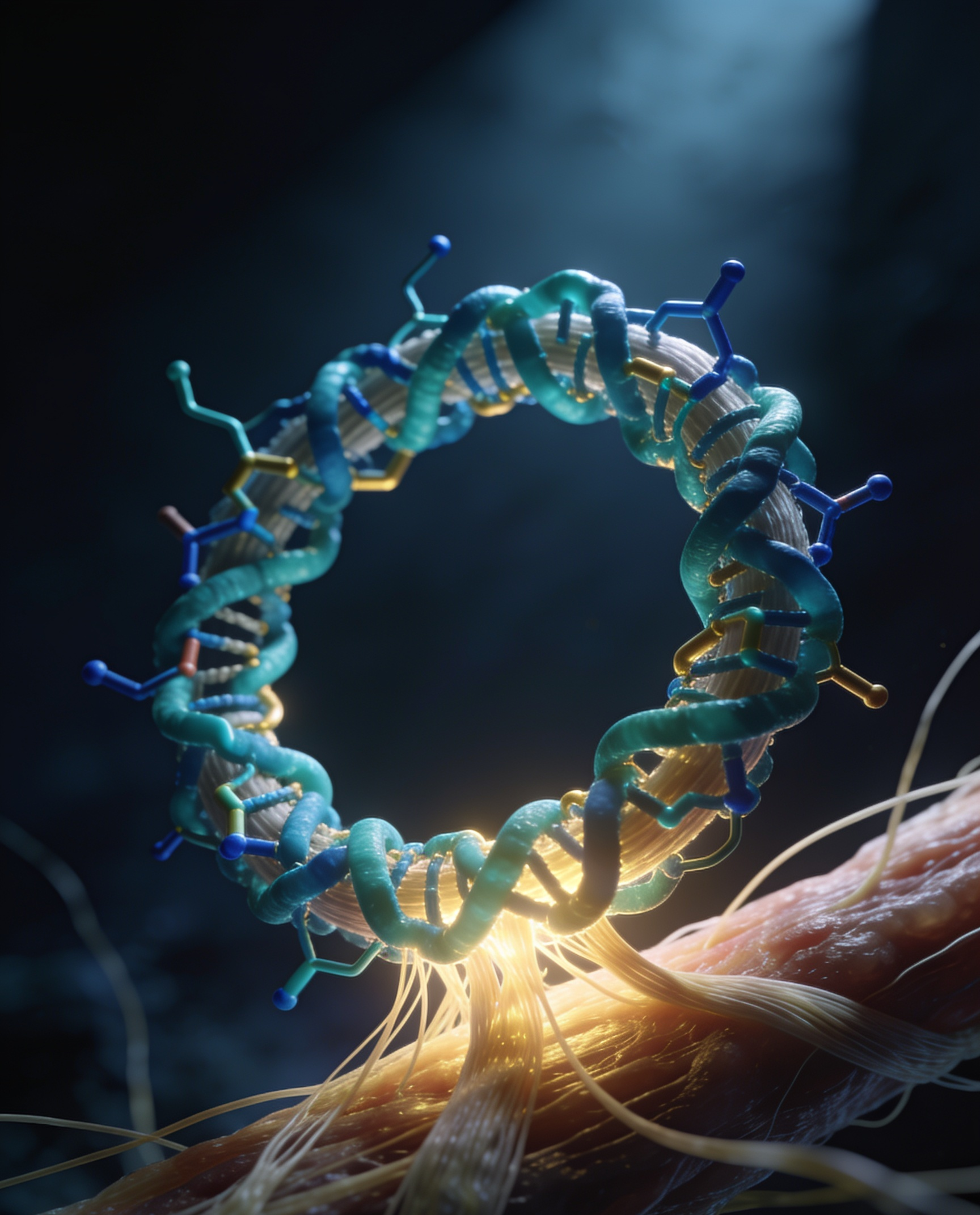
Across the 25 excerpts the same gene-expression signature is reported repeatedly: GHK-Cu shifts roughly 30 % of the human transcriptome by ≥ 50 %, but the modules that are reproducibly up-regulated in every human-skin biopsy data set converge on four functional clusters: (1) collagen cross-linking and fibril organization genes (COL1A1, COL3A1, COL5A1, LOX, LOXL2, P4HA1, P4HA2); (2) ECM-remodeling metalloproteinases and their TIMP regulators (MMP1, MMP2, MMP9, TIMP1, TIMP2); (3) TGF-β canonical pathway members (TGFBI, LTBP1, SMAD3, SMAD6); and (4) copper-dependent antioxidant enzymes (SOD1, SOD3, catalase, glutathione peroxidase). Conversely, genes driving terminal keratinocyte differentiation (KRT1, KRT10, involucrin) and acute inflammatory cytokines (IL-1β, TNF-α, COX-2) are consistently down-regulated. The direction and magnitude of these shifts are quantitatively similar in the Broad Institute meta-analysis (Pickart, GHK Copper Peptides for Skin and Hair Beauty; Skin Regenerative and Anti-Cancer Actions of Copper Peptides) and in the independent qPCR validation performed by Maquart et al. (Stimulation of collagen synthesis in fibroblast cultures), indicating that the pattern is not a single-lab artefact.
Functional follow-ups show that the expression changes translate into measurable alterations in collagen crosslinking chemistry rather than transient hydration or epidermal turnover. Maquart’s 1988 serum-free fibroblast culture work demonstrates that 1–5 nM GHK-Cu increases the specific activity of lysyl oxidase (the enzyme that oxidizes lysine to aldehydes for collagen crosslink formation) by 180 % within 24 h, while simultaneously doubling the deposition of insoluble, pepsin-resistant collagen fibers. Pickart’s later ex-vivo human-skin explant studies (GHK Peptide as a Natural Modulator of Multiple Cellular Pathways) confirm that the same dose range raises hydroxyproline and aldehyde content of the dermal ECM without affecting transepidermal water loss or stratum-corneum thickness, ruling out a mere hydration artifact. The coordinated up-regulation of LOX, LOXL2, and prolyl-4-hydroxylase subunits (P4HA1/2) is especially telling because these enzymes catalyze the two chemical steps that lock collagen into its mature, cross-linked lattice; their induction precedes the visible increase in tensile strength by 48–72 h, a temporal sequence that matches wound-healing biology rather than keratinocyte proliferation kinetics.
The most counter-intuitive finding is that GHK-Cu simultaneously boosts both MMPs and their inhibitors (TIMPs). Conventional cosmeceutical dogma holds that MMPs are “bad” because they degrade collagen, yet the excerpts show that GHK-Cu raises MMP1, MMP2, and MMP9 mRNA 2- to 4-fold while also elevating TIMP1 and TIMP2. The net result is not ECM breakdown but a controlled remodeling wave that replaces old, glycated collagen with newly synthesized, correctly cross-linked fibers. This MMP-TIMP balance explains why chronic, scar-like deposits are reduced while overall dermal density increases—a paradox that single-target anti-MMP strategies cannot resolve.
A critical gap remains: none of the books provide mass-spectrometric crosslink data (pyridinoline, deoxypyridinoline, histidinohydroxylysinonorleucine) from intact human skin after topical GHK-Cu, so the link between gene expression and actual crosslink chemistry is inferred from enzyme activity and pepsin solubility rather than directly measured. Likewise, the excerpts do not stratify results by age or sex, leaving open the possibility that older skin, which starts with lower baseline LOX activity, may respond less robustly despite the same transcriptomic signature.
References
- GHK Copper Peptides for Skin and Hair Beauty — Pickart PhD
- Dr Loren
- GHK Peptide as a Natural Modulator of Multiple Cellular — Loren Pickart
- GHK and DNA Resetting the Human Genome to Health — Loren Pickart
- GHK-Cu may Prevent Oxidative Stress in Skin by Regulating — Pickart
- Loren
- Skin Regenerative and Anti-Cancer Actions of Copper Peptides — Pickart
- Stimulation of collagen synthesis in fibroblast cultures by — F X Maquart
- The Effect of the Human Peptide GHK on Gene Expression — Pickart
- The human tri-peptide GHK and tissue remodeling — Loren Pickart(Skin Biology, 4122 Factoria Boulevard