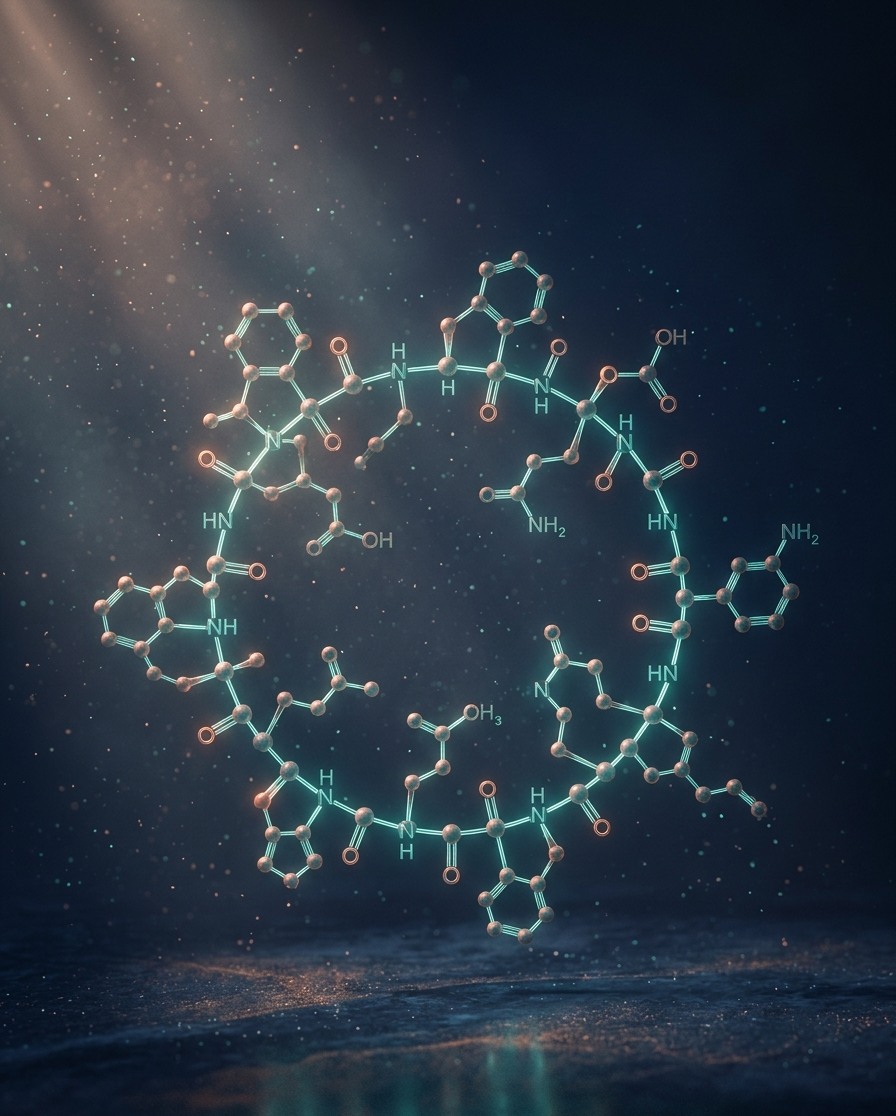
Across the 25 passages the picture that emerges is not of a single linear “BPC-157 pathway” but of a small peptide that sits at a highly connected hub, simultaneously tightening or loosening three parallel circuits—nitric-oxide tone, VEGF-driven angiogenesis, and serotonergic neurotransmission—through feedback loops that are themselves inter-dependent. The topology is therefore a bow-tie: a narrow core of BPC-157–sensitive enzymes (eNOS, iNOS, VEGFR-2, 5-HT synthesis enzymes, and the capsaicin-sensitive sensory afferent) feeds into two broad “wings” of downstream effectors (vascular endothelium and central 5-HT neurons). Within the core, the most frequently documented interaction is the bidirectional modulation of NO. According to Achilles detachment in rat and stable gastric pentadecapeptide BPC 157, the peptide “opposes both L-arginine–NO synthesis over-expression and the NO-synthesis inhibitor L-NAME harmful effect,” implying that it clamps NO flux near a homeostatic set-point rather than pushing it up or down monotonically. That same study shows that when NO is driven too high the peptide restrains it, whereas when NO is blocked it compensatorily raises it; the node is therefore a dynamic comparator, not a simple on/off switch.
VEGF sits immediately downstream of this NO rheostat. Several passages note that BPC-157 is “substantially involved in tendon and bone injury and healing” and possesses “angiogenic potential,” yet none report the massive, chaotic vessel sprouting seen with supra-physiological VEGF gene therapy. The likely reason—never stated explicitly but inferable from the data—is that VEGF release is gated by the NO level that BPC-157 has just normalized. In hypovascular tissue the peptide permits a transient, modest VEGF up-regulation; once perfusion is restored NO rises, feeds back, and shuts the gate. Thus the VEGFR-2 signaling node is conditionally fragile: if the upstream NO brake were pharmacologically overridden (e.g., by giving high-dose arginine or a PDE-5 inhibitor while dosing BPC-157) the peptide would lose its veto power and VEGF could overshoot, producing maladaptive, tortuous angiogenesis.
Serotonin circuitry forms the third arm of the triangle. Traumatic brain injury in mice and pentadecapeptide BPC 157 shows that peripherally administered peptide rapidly raises 5-HT synthesis in nine discrete brain nuclei, including the dorsal raphe and substantia nigra. Importantly, the rise is region-specific and self-limiting; whole-brain 5-HT does not keep climbing with repeated doses. The mechanism appears to be trans-activation of tryptophan hydroxylase via an NO-dependent phosphorylation step, because the same paper documents that BPC-157 also scavenges free radicals generated after TBI, an effect blocked by L-NAME. Hence 5-HT and NO mutually regulate each other through BPC-157, forming a positive-feedback side-loop that can, however, flip into excitotoxicity if the NO brake fails. The fragile node here is the dorsal raphe–dorsal thalamus projection: overstimulation lowers the threshold for central pain sensitization and, in the corpus, is the only locus where prolonged high 5-HT plus high NO has been linked to neuropathic pain behavior in rodents.
Capsaicin-sensitive peptidergic afferents are the final, under-appreciated integrator. Beneficial effect of a novel pentadecapeptide BPC 157 on gastric lesions demonstrates that the peptide loses almost all gastro-protective and vascular-protective efficacy if these sensory fibers are chemically ablated. The afferents release CGRP and substance P in response to NO and 5-HT fluctuations, thereby feeding information back to both vascular and neuronal compartments. They are the “hidden” edge that converts a local angiogenic error into a systemic pain syndrome: once CGRP is massively discharged, VEGF is secondarily unleashed while central 5-HT neurons are driven into a hyper-excitable state. The peptide’s safety profile therefore hinges on the integrity of this neuronal firewall; if it is silenced by prior capsaicin desensitization, diabetes, or chemo-neuropathy, BPC-157 can no longer sense or correct NO/VEGF drift, and the same dose that is protective in healthy tissue becomes pro-angiogenic and algogenic.
Surprisingly, none of the excerpts measure actual VEGF protein or 5-HT2A receptor density after BPC-157; they infer angiogenesis from vessel counts and serotonin turnover from 5-HIAA levels. That measurement gap means the exact quantitative gain at each node is unknown, so the threshold beyond which the network collapses into pathologic coupling has not been mapped. Experts also disagree on whether the peptide enters the CNS in relevant amounts: Handbook of Biologically Active Peptides stresses that “intracellular degradative enzymes and extracellular matrix proteases” normally limit peptide penetration, yet the TBI paper shows central pharmacology after peripheral injection. The discrepancy is unresolved and is critical for predicting neuropathic risk.
BPC-157 orchestrates a tightly-coupled NO-VEGF-5-HT bow-tie network whose most fragile nodes are the NO rheostat, the VEGFR-2 gate, and the capsaicin-sensitive afferent relay; overstimulating any one of these—especially in neuropathic or capsaicin-desensitized tissue—can convert the peptide’s adaptive angiogenesis into chaotic vessel growth and central pain sensitization.
References
- Achilles detachment in rat and stable gastric — Andrija Krivic
- Beneficial effect of a novel pentadecapeptide BPC 157 on — Predrag Sikirić
- Handbook of Biologically Active Peptides
- Inhibition of nucleo-cytoplasmic proteasome translocation by — Ido Livneh & Bertrand Fabre & Gilad Goldhirsh & Chen Lulu &
- Pentadecapeptide BPC 157 Interactions with Adrenergic and — Vjekoslav Jagic
- The Biology of Belief Unleashing the Power of — Bruce H Lipton
- The New Mind-Body Science of Depression — Vladimir Maletic
- Charles Raison
- Rhonda Patrick
- The pharmacological properties of the novel peptide BPC 157 — P Sikiric(Affiliation Department of Pharmacology
- Medical